
Best Automatic Pet Feeders 2026: Reviews & Comparison
769 views
Anyone who has ever rushed home because dinner time for the cat was approaching knows the feeling. You glance at the clock, wonder if traffic will ruin your plans, and then remember—pets don't understand meetings, delayed flights, or late-night overtime.
An automatic pet feeder fixes part of that problem. Not all of it.
Some models are impressively reliable for months. Others work perfectly until Wi-Fi drops, batteries die, or a piece of oversized kibble jams the dispensing wheel. I've tested enough feeders over the years to learn that the small details matter far more than the marketing claims.
Here's what actually deserves your money in 2026.
What Makes an Automatic Pet Feeder Worth Buying?
The biggest difference isn't Wi-Fi.
It's consistency.
A feeder that dispenses 50 grams every single meal without clogging is more valuable than one packed with smartphone features that occasionally misses breakfast.
Most quality feeders released over the last two years share several characteristics:
Dual power support (AC adapter plus backup batteries)
Scheduling for at least 6–10 meals daily
Food storage sealed against humidity
Portion control measured in small increments
Removable stainless-steel food bowls
Anti-jam dispensing mechanisms
Dry food remains the standard. Nearly every mainstream feeder works best with kibble measuring roughly 2–15 mm in diameter. Larger pieces can increase the chance of jams, especially with irregularly shaped veterinary diets.
Quick Comparison
Model | Capacity | Meals Per Day | Smart App | Camera | Backup Battery | Best For |
|---|---|---|---|---|---|---|
PETLIBRO Granary WiFi | 5L | Up to 10 | Yes | No | Yes | Most households |
PETLIBRO Polar | 3L refrigerated | Multiple | Yes | No | Yes | Wet food |
PetSafe Smart Feed 2nd Gen | 5.7L | Up to 12 | Yes | No | Yes | Large dogs |
WOPET Pioneer | 6L | Up to 15 | Yes | Optional camera version | Yes | Multi-pet homes |
HoneyGuaridan A36 | 7L | Up to 6 | Limited | No | Yes | Budget buyers |
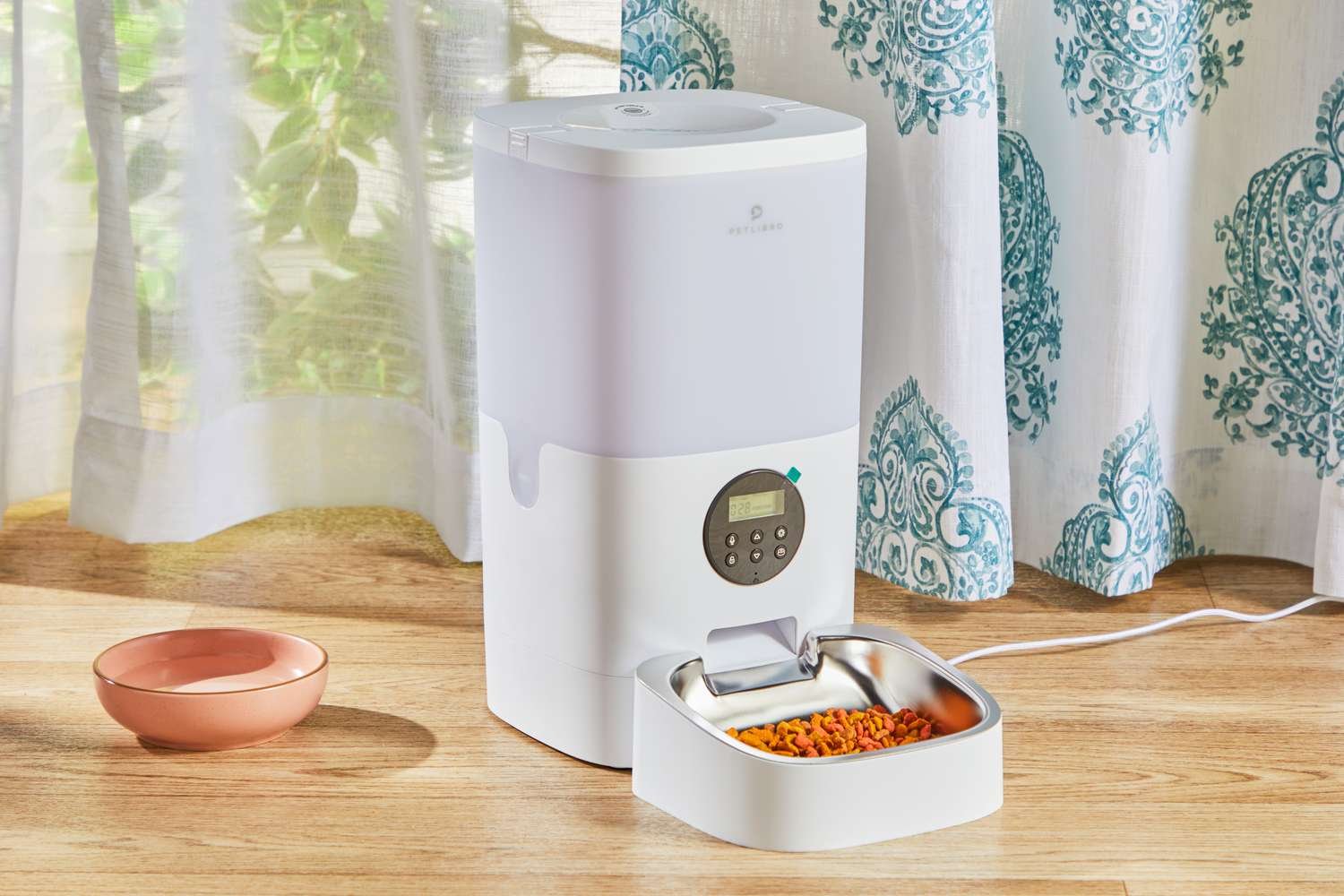
PETLIBRO Granary WiFi Feeder
This has quietly become one of the safest recommendations.
The setup isn't difficult, although there's one catch that surprises many first-time owners: the feeder connects only to 2.4 GHz Wi-Fi. That's fairly common because many IoT devices skip 5 GHz support to improve compatibility and range.
Once connected, the PETLIBRO app allows:
Remote feeding
Meal scheduling
Feeding history
Low-food notifications
Food blockage alerts on supported firmware
Its 5-liter container holds roughly 4–5 pounds (about 2 kg) of dry kibble depending on shape and density.
One detail I appreciate is the twist-lock lid. Clever pets often figure out push-button lids surprisingly fast.
The stainless-steel bowl is dishwasher safe, which cuts down on bacterial buildup compared to plastic trays.
Typical retail pricing in 2026 sits around US$90–130, depending on promotions.
PETLIBRO Polar: One of the Few Good Wet Food Feeders
Wet food changes everything.
Keeping it fresh is difficult because bacteria multiply rapidly once canned food reaches room temperature.
PETLIBRO approached the problem differently by adding semiconductor refrigeration that keeps food chilled until scheduled feeding times. Instead of relying on disposable ice packs, the Polar actively cools stored meals.
Owners feeding prescription diets or fresh food appreciate this.
Not everyone needs refrigerated feeding, though. If your pet only eats dry kibble, you're paying for hardware you'll rarely benefit from.
PetSafe Smart Feed (2nd Generation)
PetSafe has been making feeding products for years, and experience shows.
The Smart Feed doesn't chase flashy features. Instead, it focuses on reliable dispensing.
It supports:
Up to 12 scheduled meals
Slow-feed mode that spreads one meal across approximately 15 minutes
Amazon Alexa integration
Smartphone scheduling through the My PetSafe app
Large-breed owners usually like its oversized hopper. It stores around 24 cups of food, making it suitable for vacations lasting several days.
A minor annoyance remains.
The hopper can be awkward to clean thoroughly after switching foods because fine kibble dust collects around internal corners.
WOPET Pioneer Wi-Fi Feeder
Not every pet eats politely.
If you own two cats—or one determined Labrador—you'll understand why secure lid design matters.
The WOPET Pioneer includes:
Up to 15 scheduled meals
Voice meal recording
Wi-Fi scheduling
Dual power supply
Desiccant compartment for moisture control
Camera-equipped versions are available for owners who want remote monitoring.
Be realistic about the cameras, though. Most integrated pet feeder cameras stream at 1080p, enough to confirm your pet ate dinner but not comparable to dedicated indoor security cameras from brands like TP-Link or Eufy.
Pricing generally ranges between US$80–140 depending on the camera configuration.
HoneyGuaridan A36
Sometimes simple wins.
HoneyGuaridan's A36 skips many cloud-connected features while keeping dependable scheduled feeding.
Less software often means fewer headaches.
There's no worrying about app outages or firmware updates changing menu layouts overnight.
Battery life is respectable, especially if you aren't triggering the motor constantly throughout the day.
Budget-conscious owners can usually find it around US$60–80.
Wi-Fi Sounds Great... Until It Doesn't
Here's something manufacturers rarely emphasize.
Most automatic feeders continue dispensing scheduled meals without internet access once programming is stored locally. Wi-Fi primarily enables remote control and notifications.
That's a huge distinction.
If your router reboots overnight, your pet generally still gets breakfast.
Problems appear after power failures if batteries aren't installed.
Always use the recommended backup batteries—even if you never expect an outage.
Real-World Problems Owners Actually Run Into
Marketing photos show perfect kibble.
Reality looks different.
I've seen feeders jam because owners mixed two brands with completely different kibble sizes. One round pellet rotated smoothly while the larger triangular pieces wedged inside the dispensing wheel.
Another surprisingly common mistake?
Overfilling the hopper before inserting the desiccant pack correctly. Moisture slowly softens food, increasing the chance of clumping in humid climates.
If you live somewhere with consistently high humidity, replacing desiccant packets every few months genuinely helps.
Cats introduce another challenge.
Some quickly learn that bumping the feeder repeatedly shakes loose extra kibble. Better-designed units include anti-paw mechanisms that reduce accidental dispensing.
Not perfect. Better.
Smart Features That Actually Matter
Manufacturers advertise dozens of features.
Only a handful noticeably improve everyday use.
Feature | Worth Paying For? | Why |
|---|---|---|
Backup batteries | Yes | Prevents missed meals during outages |
Stainless-steel bowl | Yes | Easier cleaning and improved hygiene |
Food jam detection | Yes | Prevents silent feeding failures |
2.4 GHz Wi-Fi support | Yes | Better compatibility with home routers |
Voice recording | Maybe | Helpful for anxious pets |
Camera | Depends | Useful for travel, unnecessary for many owners |
Cloud-connected feeders generally receive firmware updates through companion apps. Always install updates from the manufacturer's official application, as they often improve motor timing, bug fixes, and notification reliability.
How Much Should You Spend?
Price doesn't always equal reliability.
Here's a realistic breakdown.
Under US$70
Basic programmable feeders with manual controls. Suitable if you simply need consistent feeding schedules.
US$80–130
The sweet spot.
Most dependable Wi-Fi models fall into this category and include battery backup, stainless bowls, scheduling, and smartphone apps.
Above US$150
Expect cameras, refrigerated storage, premium materials, or advanced monitoring features rather than dramatically better feeding accuracy.
Cleaning Is More Important Than Most People Think
Automatic feeders aren't "set and forget."
Food oils gradually coat internal components.
Most manufacturers recommend:
Washing removable bowls weekly
Cleaning the hopper every 2–4 weeks
Replacing desiccant packs periodically
Inspecting the dispensing wheel for crumbs or broken kibble
Avoid submerging electronic bases.
That sounds obvious until someone does exactly that.
Who Should Buy Which Feeder?
If reliability is your top priority, the PETLIBRO Granary WiFi strikes the best balance between price, software, and feeding consistency.
Owners feeding canned or fresh meals should seriously consider the PETLIBRO Polar, one of the few refrigerated systems that addresses food safety rather than simply delaying spoilage with ice packs.
Large dogs that empty bowls in seconds often benefit from the PetSafe Smart Feed, thanks to its generous storage and slow-feed option.
Budget shoppers can confidently choose the HoneyGuaridan A36 if remote smartphone access isn't a priority.
Frequently Asked Questions
Can automatic pet feeders work without Wi-Fi?
Yes. Most modern feeders store feeding schedules locally. Wi-Fi is usually needed only for remote control, notifications, and changing schedules while you're away.
Are automatic feeders safe for cats and dogs?
Generally, yes. Quality feeders include anti-jam mechanisms, secure lids, and battery backup. They should still be checked regularly to ensure food is dispensing correctly.
How long can dry food stay inside the hopper?
Most manufacturers recommend using food within several weeks. Keeping the hopper clean and using desiccant packs helps preserve freshness, especially in humid environments.
Can two pets share one automatic feeder?
They can, but it isn't ideal if one pet eats significantly faster than the other. Multi-pet households often achieve better results with separate feeders or microchip-controlled feeding systems.
Do automatic feeders replace daily pet care?
No. They automate feeding schedules, not companionship, exercise, grooming, or health monitoring. Someone should still check on your pet regularly, particularly during extended trips.
Choosing an automatic feeder isn't really about buying the model with the longest feature list. It's about finding the one that keeps delivering breakfast on time after months of daily use—not just during the first week. Before placing an order, measure your pet's kibble size, decide whether remote control actually matters, and make battery backup a non-negotiable requirement. Your future self—and your impatient pet—will appreciate the extra thought.
automatic pet feeders 2026
best automatic pet feeders
smart pet feeders
automatic cat feeder
automatic dog feeder
pet feeder reviews
pet feeder comparison
wifi pet feeder
timed pet feeder
best pet feeders for busy owners
Found this helpful? Share it!